How To Win LARP
Ok, bear with me here.
There’s a common understanding among most LARPers I’ve met, and it is that you can’t “win” at a larp. Typically, all the players are there to enjoy the drama and action that unfolds every event, the plot continues over a long period of time, and no one is put on a pedestal at the end of a weekend and declared a winner.
However, I disagree. I’ve been LARPing for nearly 13 years now and I’ve seen a lot of different styles of play. The first LARP I ever went to seemed neat when I first started, but as I continued to play I noticed a lot of the same people getting all the plot and cool items and such. Eventually I realized that I would never get to see anything relevant to the plot and that I was just there to support their game with my money and be the occasional lackey. I left long after I should have, and I’m glad I did.
The people that were getting all the plot and wicked loot and In-Game political power were all friends along with everyone on the game’s plot team. If anyone of their characters died, plot would find a way to bring them back with no penalties to their characters. If those players asked for items far beyond the reach of anyone else, they would get them free of charge. These people could not be touched, ever.
So yes, you can win a LARP. And I have a step-by-step guide to being the king of all LARPers just for you!
Step 1: Be A Colossal Jerk
You need to be a horrible person in the first place to even considering trying this at all. Whether you’re a sociopathic bastard, love the feeling of schadenfreude, or just have a general feeling of apathy for others, this step is critical in winning any LARP.
Step 2: Bring Friends That Are Also Colossal Jerks
Even though you’re trying to be on top, there’s strength in numbers. Make sure you’re friends are on board, plan ahead, and make sure that they don’t care about anyone else besides your little clique.
Step 3: Make A Character That Is As Ruthless As Possible
Take a good look at all the options available to you, both in terms of statistics and skills, and in-game cultures and backgrounds. Pick skills that are easily exploited and get the most bang for your buck. For background, look carefully and choose whatever background to justify any and all of your power-gaming and gives you the path of least resistance. If there’s a race that covets power, pick that. If there’s a culture that believes the ends justifies the means, pick that. If there are options that allow for some political power right off the bat, pick the one that’s going to give you the most. Anything that will give you an edge over anyone else or justifies the abhorrent behaviour you’re about to embark on, go for it.
Step 4: Get Really Chummy With Plot
This one is pretty crucial. The greater a friend plot is to you on an Out Of Game basis, the more likely they’ll give you more to do than anyone else, and be more lenient when things go wrong. Invite them into your little clique on an Out Of Game level: invite them to barbecues, throw them birthday parties, anything to get on their good side.
Step 5: Be A Rules Lawyer At All Times
Argue everything. Deny being hit by that spell. Fudge how much damage you’ve taken (no one notices small amounts) and claim you still have health left if anyone calls you on it. Claim that mage didn’t say the correct words. No matter how trivial, argue it to no end to get the upper hand. Even be a rules lawyer when it comes to In-Game lore and background. If someone is being even one iota off from their race or background, tell them they’re LARPing wrong. The more someone outside of your group doesn’t want to play, the more play time for you.
Step 6: Get As Much In-Game Power As Possible
Strive to get as much loot as possible. This includes killing other characters, stealing (In-Game, of course), and so forth. Hoard as much of it as possible, and only bring it out when you know you’ll look like a hero that saves the day. Be chummy with the local NPC authority, if any, and if you do enough, they’ll make you a leader and give you the means to run the locale you’re in as you see fit.
Step 7: Never Let Anyone Else Get Anything Cool
Once you get political power, use it. If you see a new player get a neat item, take it from them and claim that you know someone that needs it more. If someone gets a leg-up, kill their character and claim they committed treason or the like. No one should threaten the power you and your clique have gained. Ever.
Final Step: Get Kicked Out
You made it! Years of being a dick to everyone that doesn’t matter has paid off. You have all the money in the world, you sleep on a pile of magic items, and everyone does what you say under fear of death. Plot comes to you and your friends and no one else, and even if you did fail somehow, plot has your back.
It’s usually at this point that the rest of the players start leaving in droves as a result of your power-gaming, and if the owners don’t have their heads up their butts, they’ll likely pin it on your posse. So they’ll take Out Of Game measures to make sure you stop this behaviour. They may tell plot to permanently kill your characters, strip you of political power, or just outright ban you from the game. And at that point, you win! No In-Game thing could stop your reign of terror and as a result the game broke, and now you’re being thrown out. Other LARPers in the area now treat this LARP like a joke, and will possibly never recover from your shenanigans.
Congrats! You win!
The Puzzle Monster
Whoa! A post not exclusively about LARPing on a site about Game Design! Wow!
Ok, that’s out of the way. On to the topic at hand!
A puzzle monster is an encounter in a game in which the standard beat it to death with your choice of death-dealing method doesn’t work, or is very ineffective, but has a weakness or strategy the player must discover on their own. You find these often with boss enemies in video games.
Puzzle monsters can be done very easily, but they can be also done badly. A good puzzle monster is one that can be defeated by any player, regardless of any skills or abilities the player may possess at the time.
E.V.O. The Search For Eden for the SNES has a simple puzzle monster at the end of the first chapter (if you’ve never played it, I recommend getting a SNES emulator and playing it. Great game). You are a fish at that point, and the boss is a Great White Shark. It charges at you often, and if it gets close enough to you, it bites you for massive damage. If you try to bite it normally, it will either bite you back or smack you with its tail, also for large amounts of damage.
The trick is to stay near one of the cave walls where the Shark dwells, and wait for it to charge, then move out of the way. The Shark will hit the wall, and become stunned, giving the player an opening to attack the Shark. Repeat a few times, and the Shark explodes into large portions of fish sticks (sorry if I spoiled this one for anyone, but later bosses are a LOT harder). Because of this strategy, you didn’t necessarily need to have all of the cool evolutions to beat the monster.
A bad puzzle monster, however, can endlessly frustrate the player. A couple of years ago, I attended a LARP which had a REALLY bad Head of Plot. Among many of his poor choices were puzzle monsters which had a very specific weakness, all of which were in the form of a skill in the rule book. A specific kind of magic spell or the like. If a character did not possess this skill, they had no possible way of defeating the puzzle monster. This led to a lot of frustrated players, especially less experienced players that left simply because the difficulty curve was just made too high as a result.
It doesn’t have to be hard to design a puzzle monster, regardless of what kind of game you’re designing it for. Simple examples include:
- A monster that can only be damaged while standing in a specific area
- A monster that can only be damaged while the player is standing in a specific area
- A player must stand in a certain spot for a certain time to gain a sort of buff that allows the character to damage the monster, but has a very short time span, so the player must go back to that spot repeatedly.
- The monster has a weak point that the player must hit in order to affect the monster in any way
Even a simple puzzle monster like the examples above can be rewarding for a player just for defeating it. Giving loot or the like as a reward isn’t always necessary as a result, depending on the difficulty level of the encounter. The player can walk away knowing that they took down something that was seemingly impossible to defeat with their own abilities, not being held back by the numbers on their character sheets.
Puzzle monsters can be challenging and rewarding, but if you design them badly, all you end up with is a bunch of pissed off players. Designing puzzle encounters around circumstances that anyone can pull off, regardless of the skills of the character a player is playing, will be far more rewarding than loading it up with skill immunities, and I guarantee it!
Metagaming and You
There are many ways of cheating in so many games. In video games, you can enter cheat codes to make the game easier, or if you’re savvier with programming, you could hack into the games files and make any alterations you want. In Table-Top Role-Playing Games, you can cheat by fudging your dice rolls, or improperly recording numbers on your character sheet to your benefit. In childhood games like Tag, there are plenty of arguments about who got who. By far, the most infuriating and hard to control form of cheating in RPG games, and especially Live Action Role-Playing games, is Metagaming.
So what is Metagaming? For most, it’s taking information you know about the game as the player, but your character couldn’t know, and using it as your character in the game to your advantage. It is considered a form of cheating, and is a social faux pas in many RPG social circles.
For Example, Bob, who plays Bobbert the Horrid, is chatting at the bar with his LARPing buddy, Jack, who plays Jackininny, Viscount of Bards. Jack mentions to Bob after a few drinks that he managed to steal a valuable amulet from a local baron. They did not agree to share this information In-Game (or IG, as I’ll refer to it from now on), but talked about it Out-Of-Game (or OOG). Later, at the next LARP event they are attending together, Bob, as Bobbert, attacks Jackininny and steals the amulet from him. Bob used OOG information his character did not possess and used it to his character’s advantage, even though there was no way Bobbert the Horrible could have ever known that information. Bob has cheated.
Being on the bad end of this form of cheating is never any fun, especially when proving it happened is very difficult. I remember my early days at the LARP I go to now and witnessing this situation first hand. One player had a character that was very powerful, and had a decent-sized group that surrounded him. He had a reputation for taking whatever he wanted, and killing who ever he wanted (IG of course). The problem was, whenever something bad happened to him OOG that involved another player, he would take it out on them IG. With his character’s reputation of being the killer he was, claiming any sort of metagaming was hard to prove. When this character was finally defeated (due to the rest of the player population banding together to do so), he and his friends gathered in an area designated OOG to talk about who was responsible, and plan retaliation. Metagaming even in defeat.
So from what is written here so far, metagaming is bad, right? For the most part, yes it is. However, there are some forms of metagaming that are not as severe, and some we don’t even consider metagaming. We just do them because they make sense, or sometimes we don’t even realize we’re doing it. Some examples include:
– Metagaming for Safety
– Setting the Scene
– Accidental Metagaming
– Meta-Metagaming
Metagaming for Safety is something that many LARPS do, and don’t really apply to any other forms of RPGs. At every LARP that I’ve been to, there’s a “Hold Rule.” This is when someone yells, “HOLD!” and everyone within earshot drops to one knee and looks at the ground. It effectively pauses the game. This rule is used mainly for safety concerns, such as an injury, or requesting to move the combat to safer ground so that no one falls on those big sharp rocks lining the side of that ravine they’re getting pushed into. Other considerations are for those running the Plot for the event, and need to change something in the scene rapidly (Setting the Scene).
Sometimes people screw up. They forget how much health their characters have, or forget about an effect they have that is detrimental to their characters. No one is perfect. Accidental Metagaming happens when some lines get crossed about what you know IG and OOG. It can also occur if you have multiple characters in a game. Having to remember what you know and do not know can be hard enough, it gets harder when you have to split all that knowledge between multiple characters. Were you there as Cuddles the Discombobulator when the Queen was assassinated, or were you Penelope the Pixie Priestess? LARPing is intense enough at times when you play one character. When you play multiple ones, it just adds to the difficulty.
Then, there’s something I never considered until I started writing this, but makes a lot of sense. Metagaming while Metagaming. Whoa….
This is common in situations with the Hold Rule. You’re in an intense fight, surrounded by enemies. Then someone calls a Hold nearby due to being hit in the head too hard, and everyone drops to their knees and looks at the ground. Because you don’t have anything to do with why the hold was called, you have time to think about what you’re going to do. Formulate an escape plan, recall that magic item in your bag you forgot about.
Unfortunately, this is a form of metagaming. But it does happen. Our brains are wired for survival, even pretendy fun-time survival. We can’t help it. And you can’t prevent it from happening. Sure, your head will still be down while in the Hold, so you can’t survey your surroundings, but you’re still formulating a plan in your head while the game is paused. There’s no way of preventing this sort of instinctive metagaming.
So, how do we prevent metagaming from ruining an event for someone? Well, metagaming for safety purposes doesn’t ruin anyone’s time. In fact, it makes it so it isn’t ruined for someone. When using it for setting a scene, if done correctly, can enhance the player-base’s experience. Accidental and Meta-Metagaming does happen, and it’s something that cannot be prevented. It’s not necessarily as terrible thing as intentional metagaming, however.
Speaking of which, intentional metagaming is a bad thing, as explained in the earlier portion of this essay. It is a form of cheating and needs to be addressed. Preventing it isn’t as easy as it sounds, but involves conflict resolution on an OOG level. Those running the game should take the time to ensure that those that players that don’t get along OOG will not take it out on each other IG. A talk between all parties involved should be a necessary step. After that, the situation should be monitored closely for a while, to ensure that the chat had an effect.
Usually, if the metagamer really is metagaming, and doing it a lot, these people are usually found out and warned, and eventually removed from the game one way or the other, as was the case during those early days at the LARP I attend now. They usually leave on their own volition after complaining that no one wants to play with them, or are removed by whatever process the LARP in question has for handling such problematic players.
To prevent metagaming, however, is knowing what it is and being conscious of it when while LARPing, or just hanging out with the friends you LARP with. I for one enjoy listening to the stories of my friends’ character’s escapades, but I make sure that if I recall those things while I’m playing my character, to ask if I can recall hearing about it as my character. If I play multiple characters, I could keep a journal for each character I have so that I can look back and see if the character I’m playing at the time would recall the relevant information.
My character also has secrets. Knowledge he doesn’t want to give freely, or items he doesn’t want anyone to know he has. I keep those to myself, even though talking about these things OOG would be cool. This keeps others from metagaming, even if it’s accidental when it would happen.
Some go as far as to not talk about what happens to their characters, unless it’s a story that a lot of people have seen already, or want to hear about other’s stories, so they don’t metagame later. I think it’s a bit extreme, but I get the point.
Metagaming is bad, for the most part. It can ruin an event for a player, especially if it is the cause of losing the ability to play a character that you’ve worked hard on over the years. But the bad metagaming is preventable. It just takes a little forethought and practice.
In short, only you can prevent metagaming!
Stepping Tiles
This game was made during the 2012 Toronto Game Jam. I partnered up with a flash programmer for this one, and focused on art and design. A lot of paper prototypes were made for the creation of the main levels. It was down to the wire on this one, but we pulled it off with 30 seconds to spare (I’m not kidding on that, either).
Stepping Tiles is a single-player puzzle game. It is similar to a sliding tile puzzle, but instead of a piece of an image, each tile has paths on it. A small man walks along these paths, and the player must slide tiles to complete the paths and help the man gather fruit. Gathering all of the fruit wins the level. There are eight levels total, with each level gradually becoming more harder, and adding new types of paths to the game. There’s also a Random Level which completely randomizes the tiles which is horribly unbalanced but fun to attempt!
Programs Used: Adobe Flash, Photoshop, Illustrator
To play: Install Adobe Flash Player, and double-click the file. If that does not work, open the file in Internet Explorer.
Snake Run
This was a Flash game I made during the Toronto Global Game Jam in 2012. I came in intending to be an art floater, but the Jam was planned so close to the date that they didn’t have time to organize a way for floaters to really be facilitated, so I was on my own. I was recommended StencylWorks by one of the organizers, a Flash game maker that makes coding visual-based. By the end of the weekend, and after going through several tutorials, I managed to complete a simple platformer game before anyone even had a functional game.
Snake Run is a 2d platformer game in which you must navigate jumping puzzles in order to outrun the giant snake running behind you. There are five levels, each level being more difficult than the last.
Programs Used: Adobe Flash, Photoshop
To Play: Have Adobe Flash Player installed on your computer, then double-click on the file. If that does not work, open the file in Interned Explorer
Cartoon Mime
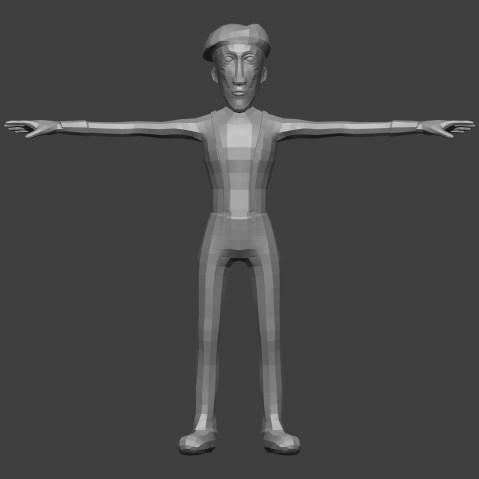
This gallery contains 7 photos.
One of the projects I had to do over the last couple of semesters was to create a short 3D movie alongside an animator. I created all 3 characters in the scene, and this is the main protagonist: a french mime. I wanted to have pieces that were varied in terms of style, and we […]
Bill The Butcher

This gallery contains 10 photos.
Gangs of New York is one of my favorite movies of all time. Great acting, great story, and it showed a piece of history that many people, even those living in New York City today, never really knew about. Daniel Day-Lewis is a tremendously great actor. Every role he plays instantly becomes iconic, and Bill […]
Madrak Ironhide

This gallery contains 7 photos.
I am a big fan of Warmachine, a table-top wargame created by Privateer Press. They also have a second wargame called Hordes, which is compatible with Warmachine, with a different set of mechanics around some of the individual units. I could go on about the game, but this is about a 3D model I wanted […]
 David Henry - Game Designer
Recent Comments